

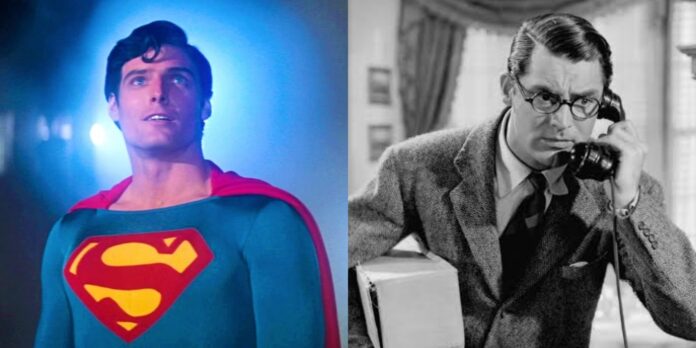
Christopher Reeve’s Superman remains the definitive live-action interpretation of the Man of Steel, not just because he made audiences believe a man could fly, but because he made them believe Clark Kent could exist.
His performance is a masterclass in dual identity acting. He is charming, sincere, physically commanding as Superman, but adorably awkward, self-conscious, and self-effacing as Clark. What is easily missed, however, is the way Reeve created that memorable contrast. His influence was not like that of other action or comic book heroes, but rather an entirely different part of film history: the screwball comedies of Hollywood’s Golden Age.
Cary Grant’s Comic Chaos Became The Blueprint For Christopher Reeve’s Clark Kent

While the source of inspiration is well-documented, the genius lies not in imitation but in transformation. Reeve took the DNA of a slapstick act and moulded it with subtlety, heart, and restraint. He created a Clark Kent whose humanity was as bright as Superman’s heroism. In the film ‘Bringing up Baby’ by Howard Hawks, Cary Grant portrays the role of David Huxley, a paleontologist whose well-organized, neat life is ruined into comedic mayhem when he encounters Katharine Hepburn’s whirlwind of a character.
Related: How Christopher Reeve’s Iconic Guest Appearance On ‘Smallville’ Elevates His Legacy In DC Universe
Grant’s David is the ideal absent-minded professor: tall, soft-spoken, and always overwhelmed. He trips, he stammers, and hardly completes a sentence without being steamrolled. Clark Kent and David Huxley have an undeniable aesthetic heritage: the heavy black-rimmed glasses, the slightly disheveled suits, the stilted posture. Both men are physically carrying the weight of someone who is attempting to look smaller than they are in reality. It is a great contrast to the fact that both actors were tall and broad.
The connection goes even deeper. The motions of Grant in ‘Bringing up Baby’ were, in part, inspired by the silent film star Harold Lloyd. Director Howard Hawks urged Grant to watch Lloyd’s movies to get the concept. Reeve, consciously or unconsciously, inherited this lineage. When Clark Kent points a shy finger at someone in a meeting and then drops it when he is interrupted, it reminds us of Grant. But Reeve doesn’t copy, he translates.
Christopher Reeve Wanted Superman To Feel Like A Real Person
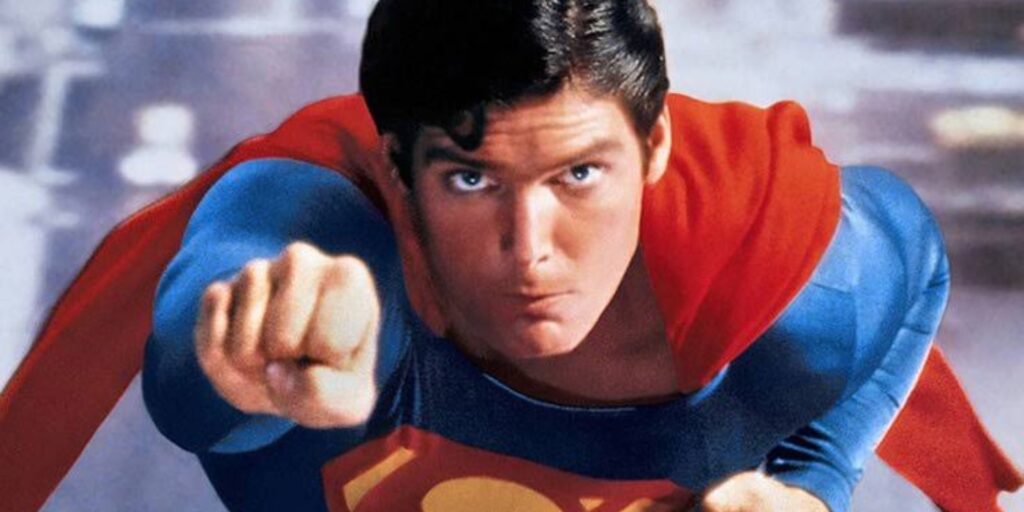
Reeve understood something fundamental about Clark Kent: he isn’t a disguise meant to mock humanity, but a love letter to it. Superman’s guiding principle that Richard Donner used in directing the film was the concept of verisimilitude. The belief that everything, even the unrealistic, should feel real. Within the confines of this philosophy, Grant had to make his frantic slapstick more grounded, smooth, and less frantic. So Reeve re-invented the comic tunes. He did not lean into farce, but into vulnerability.
In case you missed it: James Gunn’s Superman Redefined The Superhero For A Whole New Generation
Take the most humanly beautiful scene in Superman. Clark tries to invite Lois Lane to a date. She refuses without even stopping, drifting by him like a breeze. His little, deflated Oh is nearly a whisper. His coat becomes trapped in the door of the ladies’ room a few seconds later. In a Cary Grant movie, this would cause wild pulling, crazy movements, perhaps even a fall. However, Reeve merely taps on the door politely, embarrassed, but never cartoonish. It is cute, relatable, and silently funny.
And because Reeve is playing both parts with complete sincerity, Clark is as real and emotionally nuanced as Superman. For a young actor in his first big film role, to have Cary Grant as an example would have been a disaster. Had the comic touch contradicted the vision of Donner, Clark Kent would have appeared as a parody. As a result, the whole movie would have fallen apart.
Rather, Reeve discovered the right balance. He borrowed the spirit of Grant, not his exaggerations. And it resulted in one of the most recognizable oppositions in the history of cinema and a superhero act that continues to be the standard almost 50 years later. Christopher Reeve did not simply act as Superman. He re-created him.