

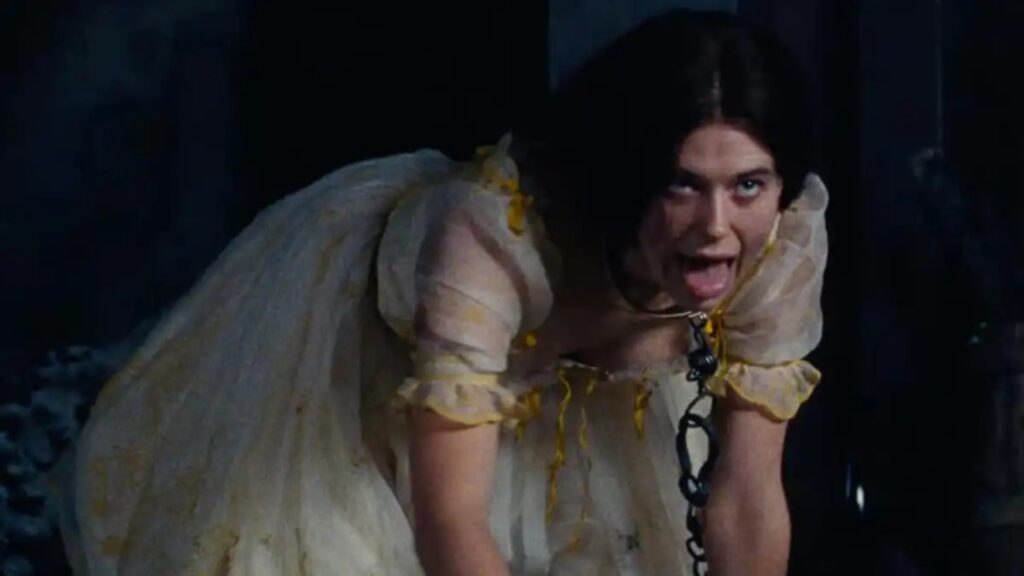
Audiences walking into ‘Wuthering Heights’ expect passion, heartbreak, and windswept tragedy. What most people did not anticipate in the new version of Emerald Fennell was a scene so aesthetically shocking that it left the theaters abuzz: Isabella, chained to the fireplace, with a dog collar on her, as Heathcliff descends into emotional devastation.
The scene has already become the most discussed addition to the film, a sharp, provocative deviation from the text. And now, the actors in the middle of it are providing an insight into what it all means.
What The Dog Collar Scene Really Says About Heathcliff And Isabella
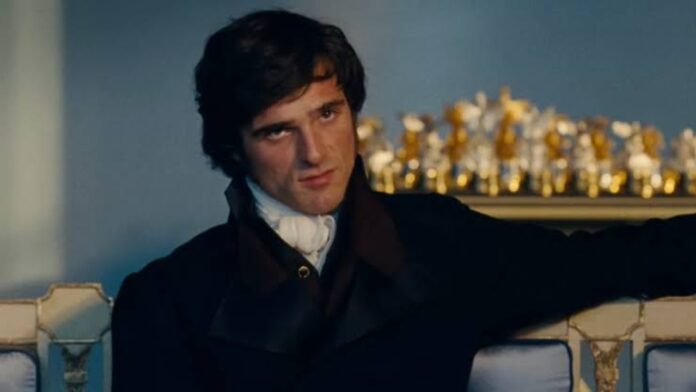
To Jacob Elordi, who portrays Heathcliff, the scene is a psychological breaking point and not shock value. He refers to the moment as the time when the long-held obsession of Heathcliff towards Cathy turns into something wild and uncontrollable. It is no longer revenge with cold-blooded calculation, but desperation in nakedness.
Related: Margot Robbie And Jacob Elordi’s Lusty Reboot Smothers Gothic Classic
Dogs are another theme in the novel and are frequently associated with violence and cruelty. The fact that Heathcliff kills Isabella’s dog in the book highlights his brutality. Fennell seems to project that darkness into one, haunting metaphor turned into a literal image. The rabid nature of Heathcliff’s love becomes unavoidable.
He is not merely heartbroken; he is self-destructing. According to Elordi, the disorder in ‘Wuthering Heights’ is a reflection of Heathcliff’s inner breakdown. The power games, which used to be dramatic, are now excruciatingly real. No pleasure in revenge anymore, just emptiness.
How ‘Wuthering Heights’ Turns Obsession Into Horror
On Isabella’s part, played by Alison Oliver, the situation is no less complicated. Oliver puts Isabella in a very repressed light, a person who is sheltered and infantilized and does not quite realize the darkness she is entering. When such repression breaks out, it breaks out messily. Critics have been split on this interpretation.
In case you missed it: Top 15 Period-Drama TV Shows Like ‘Bridgerton’
Some claim that the movie dilutes the brutality of Heathcliff by implying that Isabella is a part of the poison. Others perceive it as an experiment with perverse agency, a character who is trying to find his way through trauma in a manner that is uncomfortable yet emotionally expressive. In any case, the adaptation leaves no doubt that it is not a faithful retelling.
It is a fever-dream re-enactment of Brontë’s tragedy, but with a psychological extreme angle instead of a suppressed Gothic melancholy. The scene with the fireplace can shock the audience, yet it summarizes the thesis of the film. It shows love that is not tied to humanity turns into something unfamiliar. And in the world of Fennell, that descent cannot be overlooked.
You might like to read: Margot Robbie Says ‘Wuthering Heights’ Pushed Her Into a “Codependent” Bond With Elordi