


Quentin Tarantino has never hidden the fact that he’s a cinematic magpie. His movies steal, remix, and recontextualize the films he adores, particularly those that were once on the margins of mainstream cinema. His work coexists with grindhouse, kung fu epics, spaghetti westerns, and samurai revenge films.
However, ‘Kill Bill’ is not like his other homages. It does not merely steal imagery or plot lines; it transmits a very particular presence, one that silently determines the soul of the narrative. That is the presence of Meiko Kaji.
The Woman Who Taught ‘Kill Bill’ How To Be Cold, Silent And Deadly
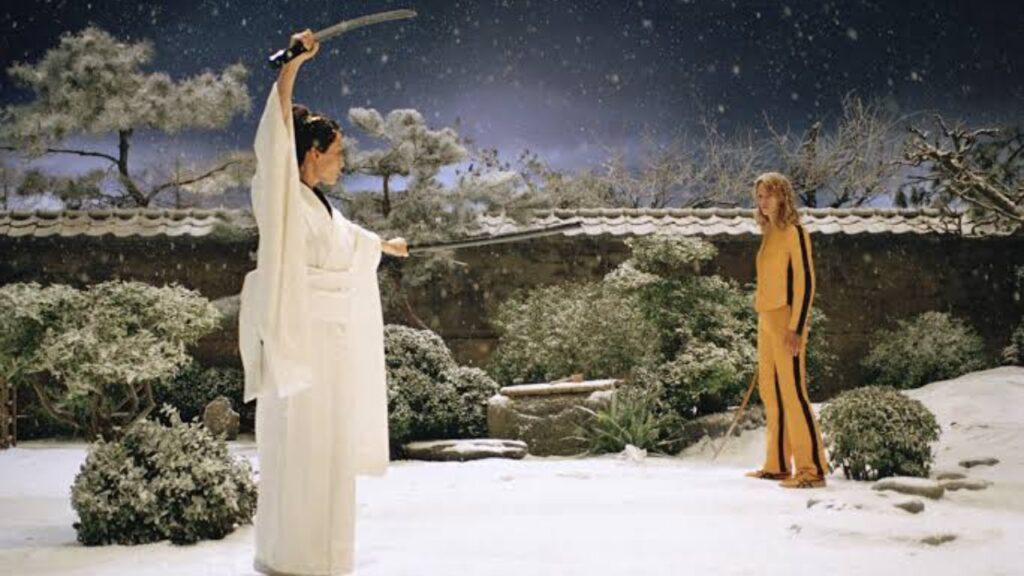
Although ‘Kill Bill’ can be frequently talked about in terms of its hyper-violence, pop culture allusions, and genre-blending swagger, its emotional heart lies in the type of stoic, restrained acting that Kaji mastered in 1970s Japanese exploitation cinema. Tarantino did not simply mention her work; he created a whole mythology of revenge around the kind of woman she was portraying better than anyone. Kaji wasn’t flashy. She did not have to spend much time on monologues to get attention.
Related: Quentin Tarantino Delivers His Ultimate Vision With ‘Kill Bill: The Whole Bloody Affair’
She stood motionless, gazed through her foes, and rendered silence which was more oppressive than conversation. That energy runs through ‘Kill Bill’ like an electric current, shaping everything from its pacing to its most iconic confrontations. The most direct influence on ‘Kill Bill’ comes from ‘Lady Snowblood’ (1973), a film that feels almost eerily familiar once you know where to look. Kaji plays the role of a woman, Yuki, who was literally born to take revenge.
Yuki is born in prison after her mother is raped and brought up with one mission of avenging the people who ruined her family. It is a tragedy, a story of violence, and destiny. Sound familiar? Tarantino has publicly admitted that ‘Lady Snowblood’ was a major influence. However, the similarities extend much further than tribute. ‘Kill Bill: Volume 1’ reflects the emotional beat of Yuki’s story, a woman who has been traumatized, who is systematically crossing names off a list, and is going forward regardless of the price.
Lucky Liu’s O-Ren Ishii is a spiritual heir to Yuki. Her childhood trauma, her rise to violence, and her cold-blooded composure are all reminiscent of ‘Lady Snowblood’s DNA. The most obvious visual reference is, perhaps, the climactic duel between The Bride and O-Ren in the snow. It is not a nod, but a recreation of ‘Lady Snowblood’s last moments, with all its stillness, the falling snow, and the purity of blood. Even the choice to use “Flower of Carnage”, Kaji’s own haunting theme song, isn’t subtle. It’s Tarantino openly tipping his hat and inviting the audience to trace the lineage themselves.
Meiko Kaji’s Silent Antiheroes Changed What Revenge Looks Like

In addition to ‘Lady Snowblood’, Kaji has established her legacy with the Female Prisoner Scorpion films, in which she portrayed Nami Matsushima, a near-mythical character of rage and strength. Nami speaks very little, but she takes over all the frames she appears in. She is not made to be likable or comforting. She is a force of consequence, who goes through a brutal system that continues to attempt and fail to break her.
In case you missed it: Why ‘Kill Bill’s True Power Emerges Only In ‘The Whole Bloody Affair’ Theatrical Cut
That archetype is all over Kill Bill’s version of The Bride. Uma Thurman’s character may talk more than the heroines of Kaji, but when it really counts, she is silent. She watches and waits before she acts. Her violence has an emotional detachment that is very Kaji-inspired, revenge as obligation, and not pleasure. It’s not fun. It’s necessary. Even thematically, ‘Kill Bill’ echoes Kaji’s work in its understanding of consequences. Revenge doesn’t end cleanly. Violence creates ripples. The Bride leaves behind witnesses, just as Kaji’s characters often do. The cycle doesn’t stop; it just pauses.