


Among the many lingering questions left by the ‘Lord of the Rings’, one quietly haunts attentive viewers and devoted readers alike: why was Gandalf the only wizard who sailed into the West?
When the white ship leaves the Grey Havens at the end of ‘The Return of the King’, Gandalf is standing next to Frodo, Bilbo, Galadriel, and Elrond. He is finally at rest and leaving Middle-earth behind. The scene is quiet, heartfelt, and very symbolic. However, it brings to mind an unpleasant question: what about the others?
Gandalf Didn’t Rule Middle-earth, He Knew When To Leave It

Radagast disappears into the shadows. The Blue Wizards disappear into myth. Saruman is killed in disgrace and without mercy. Gandalf is the only one who is allowed to pass to the Undying Lands. It seems like favoritism at first sight, as though Tolkien picked a favorite and gave him his due. However, when considered in the context of the Middle-earth lore, the departure of Gandalf is not a matter of choice at all. It is of intent, self-denial, and fulfillment.
In order to comprehend why the story of Gandalf had a different ending, one must recall what the wizards actually were. The Istari did not come to Middle-earth to govern, conquer, or even to openly overcome evil. They were messengers of the Valar, dressed in delicate, decaying bodies, and charged with leading the Free Peoples by advice and inspiration. Their authority was held back. They were meant to inspire resistance, not become the resistance.
Related: 10 Major Lord of the Rings Book Storylines the Movies Left Out
This limitation was more than any other accepted by Gandalf. He walked through the Shire to Gondor among hobbits, men, elves, and dwarves, not as a ruler but as a friend. He listened, waited, and believed in others to stand up when the moment arrived. Even in the times when he was powerful, facing the Balrog in Moria or confronting the Witch-king, these were not ambitions, but necessities. His assassination in Khazad-dûm was a turning point.
Gandalf the Grey did not want glory; he was defending others. By the time he came back as Gandalf the White, it was not a promotion that he had earned through pride but rather a restoration that he deserved because he stuck to his mission at a time when it was most needed. At the conclusion of the ‘War of the Ring’, Gandalf had accomplished just what the Valar desired: he assisted Middle-earth in saving itself. More importantly, he was aware of when to step aside. When Sauron was defeated, Gandalf did not seek to lead the new age forever.
He realized that Middle-earth was forced to expand beyond the control of the gods. His departure was a promise of trust. And there is the more intimate reason: Gandalf was a Ring-bearer. Being the keeper of Narya, the Ring of Fire, he bore a burden that, although not the same as the One Ring, had a price. Tolkien made it clear that even the lesser Rings bound their bearers to fading. As Galadriel herself acknowledged, the time of the Rings was ending. Gandalf’s passage West was not just an honor, it was a mercy.
The Other Wizards Fell Away From The Path
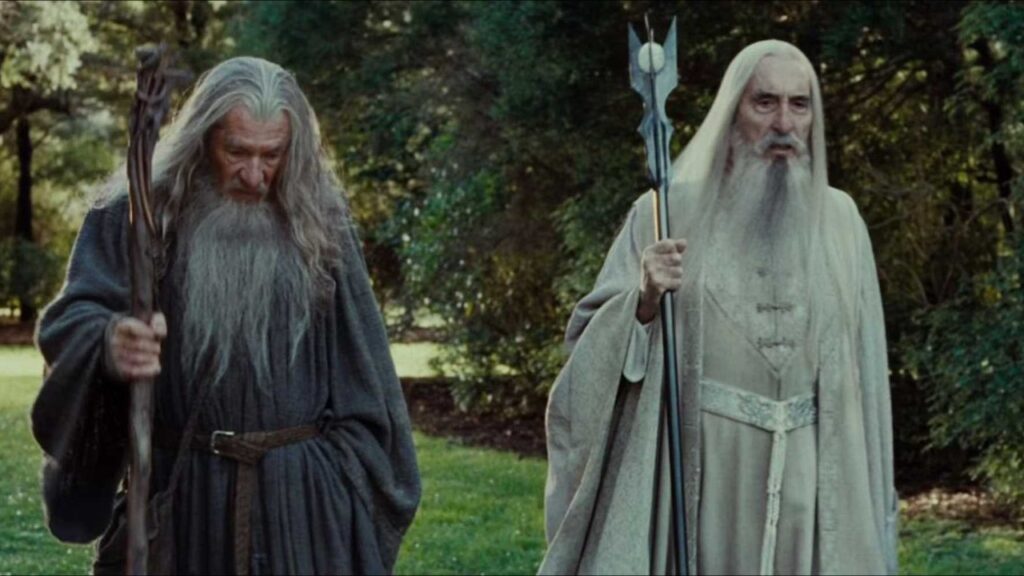
If Gandalf’s fate represents fulfillment, the other wizards embody unresolved purpose, and in some cases, tragic failure. The most obvious contrast is Saruman. He was once the wisest of the Istari, but he lost humility in favor of control. Where Gandalf had faith in people, Saruman tried to control them. Where Gandalf took boundaries, Saruman despised them.
He was obsessed with power, and this made him imitate the same evil he was sent to fight. Saruman had cut himself off by the time of his death. One of the most chilling scenes in Tolkien is the rejection of his spirit by the West.
In case you missed it: The Unbelievable Reason Why ‘Lord Of The Rings’ Books Were Banned
He was a being who was given a chance to be redeemed, but instead, he decided to be bitter. The destiny of Radagast is not so dramatic, yet no less telling. He was not an evil man, but he lost his way. His affection for nature turned into a goal in itself and not a tool to save the bigger world. While his intentions were gentle, his impact during the War of the Ring was minimal. Radagast failed not in a spectacular way, but he did not complete the task he was assigned.
Next are the Blue Wizards, which is perhaps the biggest mystery of all. Tolkien himself rewrote their tale several times, occasionally indicating that they had gone into the darkness, other times hinting they worked quietly in the East to weaken Sauron’s influence.
The only thing that is constant is that their story was not complete; it was concealed and unresolved. And that difference is essential. And that distinction is crucial. Gandalf’s ending feels complete because his arc is complete. His journey has a beginning, a crucible, and a resolution. The others fade because their stories never fully returned to the path they were set upon.
You might also like to read: Viggo Mortensen Believes Most Powerful ‘Lord Of The Rings’ Scene Had No Magic At All