


Medical mysteries are nothing new on ‘House M.D.‘, but some cases pushed the boundaries of medicine and logic far more than others. Across its eight-season run, the show built its reputation on rare diseases, strange symptoms, and diagnoses that seemed almost impossible to uncover.
While many diagnoses were rooted in real medical science, their unusual presentation made them unforgettable. Here are some of the most unbelievable cases ever solved on ‘House M.D.‘, where the truth turned out stranger than fiction.
The Man Who Mirrored Everyone Around Him
Season 4, Episode 5 – “Mirror, Mirror”

After surviving a bus accident, a patient arrives at the hospital with an unsettling problem: he no longer seems to have a personality of his own. Instead, he unconsciously mirrors the emotions and behaviour of anyone around him. If someone laughs, he laughs; if someone becomes angry, he does too. The strange phenomenon leaves House fascinated, as the man appears to function normally but lacks independent reactions.
Eventually, House concludes that damage to the patient’s frontal lobe disrupted the brain’s ability to regulate impulse control and emotional identity. While the medical explanation is plausible, the eerie loss of personal identity makes this one of the show’s most psychologically bizarre cases.
Related: 10 Unbelievable Medical Cases On ‘Grey’s Anatomy’
The Parasite Hidden in a Child’s Brain
Season 3, Episode 4 – “Lines in the Sand”
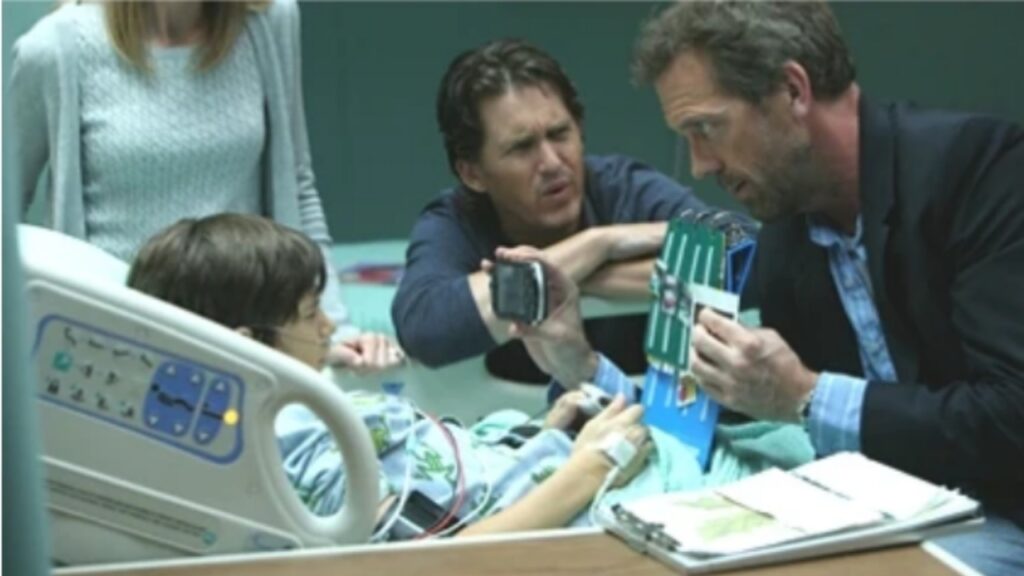
One of the most unsettling cases in ‘House M.D.‘ involves a young autistic boy who suddenly begins showing mysterious neurological symptoms. The team struggles to communicate with him, making diagnosis extremely difficult. House eventually notices patterns in the boy’s drawings and realizes they might represent something happening inside his body.
His theory leads to a shocking discovery: the child has been infected with Baylisascaris, a rare raccoon roundworm parasite capable of invading the brain. The parasite slowly damages the nervous system as it moves through the body. The idea of a hidden parasite attacking a child’s brain made this case one of the series’s most disturbing medical mysteries.
The Diagnosis No One Expected
Season 2, Episode 17 – “All In”

In this episode, a young boy arrives at the hospital with symptoms that appear completely unrelated, including organ problems, unexplained pain, and confusing test results. As the team grows increasingly frustrated, House refuses to abandon the case.
His relentless search eventually leads him to a rare and little-known condition called Erdheim-Chester disease, a disorder that causes abnormal tissue growth in multiple organs. At the time the episode aired, only a few hundred cases had been reported worldwide, which makes this one of the show’s most astonishing and unlikely diagnostic victories.
In case you missed it: ‘Chernobyl’ Fans Shouldn’t Miss This Real-Life Disaster Drama
When the Illness Was a Lie
Season 2, Episode 9 – “Deception”

Not every bizarre case in ‘House M.D.‘ involves a rare disease. In this episode, a woman arrives at the hospital displaying symptoms that appear to match Cushing’s syndrome, yet every test result contradicts the diagnosis. The conflicting evidence frustrates House’s team, as the patient’s symptoms simply refuse to follow normal medical logic.
Eventually, House uncovers the shocking truth: the woman is intentionally making herself sick in order to receive attention. She suffers from Munchausen syndrome, a psychological disorder where patients fake or induce illness. Unlike most cases, there is no physical disease to treat.
The Return of the Bubonic Plague
Season 2, Episode 18 – “Sleeping Dogs Lie”

Few people would expect a disease associated with the Black Death to appear in a modern hospital, yet ‘House M.D.‘ delivers exactly that shock. In this episode, a woman arrives with severe symptoms that don’t match any common infection. As her condition deteriorates, House pieces together an unexpected possibility: bubonic plague.
The disease, historically spread by fleas and responsible for devastating medieval pandemics, still exists in rare modern cases. Discovering that the patient has contracted such an ancient illness reminds viewers that some diseases never truly disappear.
You might also like to read: 25 Best Medical Drama Shows Of All Time