

There is a reason why every enthusiastic rewatch of ‘Easy A’ leaves you with a bit of a sour aftertaste. Even if we ignore the blatant offensive slurs that the film casually throws around or we are distracted by Emma Stone’s endlessly charismatic performance, the movie still has a problem that becomes harder and harder to ignore with time.
In trying to challenge the double standards surrounding female sexuality and slut-shaming, unfortunately, ‘Easy A’ falls back on the very stereotypes it was trying to dismantle.
Why ‘Easy A’s Take On Female Sexuality Hasn’t Aged Well
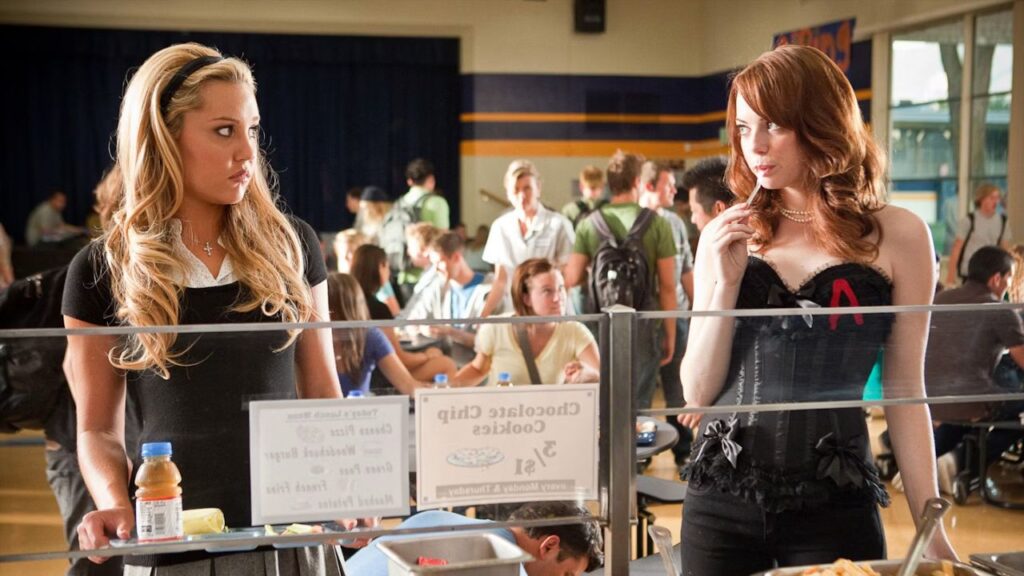
‘Easy A’ tells the story of Olive Penderghast, portrayed by Emma Stone, whose casual lie about losing her virginity spirals out of control as she goes from a nobody to the notorious “school slut”. Rather than trying to clear her name, Olive decides to lean into the reputation and sews bright red A’s onto her new provocative wardrobe. She also starts accepting money from male classmates in exchange for pretending to sleep with them.
Related: Top 10 2000s Teen Shows To Rewatch Again
It is an outrageous premise, but it is talking about the genuinely real double standards that are embedded in young minds right at high school. Boys are celebrated for their sexual conquest, while girls are condemned for theirs. Unfortunately, the film fails to create a critique of this that stands the test of time.
The problem begins with the familiar and frustrating “not like other girls” trope. Olive is intelligent, witty and self-aware. But nearly every other girl in the movie is portrayed as shallow, submissive, jealous, cruel or painfully foolish. There is her best friend Rhiannon, initially pressuring her into situations she is uncomfortable with before eventually giving in to jealousy and joining everyone in slut-shaming her. Meanwhile, Marianne appears to have little purpose beyond religiously leading the slut-shaming campaign against Olive.
The double standard in its characters is even glaring when we look at the boys. The fact that they exploit Olive’s reputation and participate in a system that rewards them while humiliating her is never questioned by the film. They aren’t held accountable with the same seriousness, and instead the film asks us to sympathise with the pressure they face to perform masculinity. That is certainly a worthwhile conversation to be had about restrictive gender expectations and how it affects boys, but that should not come at the expense of completely ignoring how it affects girls.
‘Easy A’ unknowingly reflects a very frustrating reality: men escape the consequences of their behaviour, while women are expected to bear the burden of it all. This could have been a strong part of the movie’s satirical themes, but that is not how it feels when we look at how caricatured and predictable the characters are.
‘Easy A’s Feminist Message Still Works Under A Double Standard

For all this talk about dismantling slut-shaming and empowering feminine sexuality, ‘Easy A’ still relies on and repeatedly assures us that Olive has never actually had sex. Could the romance aspect with Todd have worked if he never knew that the rumours were false? And what happens when a woman is actually sexually active and secure and has no desire to apologise for it? ‘Easy A’ still relies on its protagonist’s virginity and innocence for her to be justified in her claim for dignity and respect.
In Case You Missed It: 10 Offbeat Movies About Teenage Girls
The problem is much clearer in the way the film actually portrays sexually active women. The movie’s villain is Mrs Griffith, who is cheating on her husband, sleeping with a male student and is allowing Olive to take the public blame for giving him chlamydia. Mrs Griffith is evil, but the underlying message this characterisation insinuates is still problematic.
Because then there is Olive’s mother, Rosemary, who reveals that even she was slut-shamed back in her high school days. But in her case, she was actually having sex with everyone. Instead of telling Olive that exploring her sexuality is actually completely okay, she blames her being “a slut once” on her having low self-esteem before she met her husband. The implication is clear: sexually active women are either immoral adulterers or unhappy people who need to find the right man.
To be fair, ‘Easy A’ gets many things right. Especially the fake-sex scene where Brandon leaves the room getting cheers and high-fives, whereas Olive is seen quietly leaving as everyone smirks or stares at her. The entire critique of rigid ideas of masculinity and the slut-shaming culture remains as relevant as ever. Yet, ‘Easy A’ still falls short of its own ambition. When you compare it to movies like ‘Mean Girls’, we can see that ultimately the differences lie in how the film approaches its feminist tone. Both satirise the cruelty of high school hierarchies, but while one actually approaches its themes and characters with empathy, the other still functions under the double standard it set out to dismantle.
You Might Also Like To Read: Top 10 Underrated Teen Movies That Are Actually Brilliant