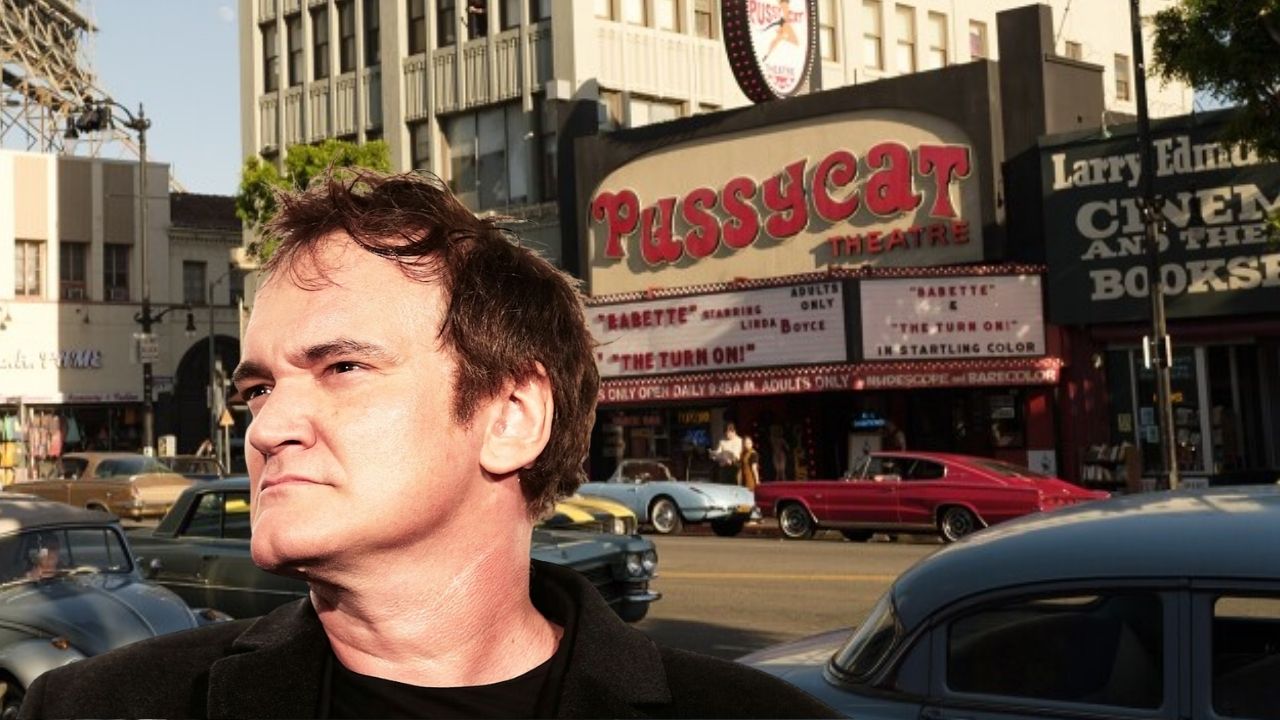
In ‘Once Upon a Time in Hollywood‘ by Quentin Tarantino, 1960s Los Angeles becomes a living, breathing part of the story. From the streets to the people, everything feels carefully placed to reflect a time of great change.
While most films simply recreate a period and settle for a surface-level set, Tarantino took a different direction. Instead, he drew from his own memories and worked closely with his team to rebuild L.A. as he once experienced it.
Quentin Tarantino’s Personal Memories Influenced the ‘Once Upon a Time in Hollywood’ Setting
Tarantino’s idea of 1960s Los Angeles came directly from his childhood. He often recalled visiting Grauman’s Chinese Theatre and studying the handprints of stars like John Wayne and Roy Rogers. Alongside those memories, one small detail stayed with him for years: a Mold-A-Rama machine outside the theater that created wax souvenirs.
Because that memory felt so vivid, Tarantino even tried to include it in the film. He asked production designer Barbara Ling to track down the machine. Although the scene did not make it into the final cut, he kept the machine, joking, “It sits in my garage,” before laughing. As a result, the film opens differently, introducing Rick Dalton and Cliff Booth, played by Leonardo DiCaprio and Brad Pitt.
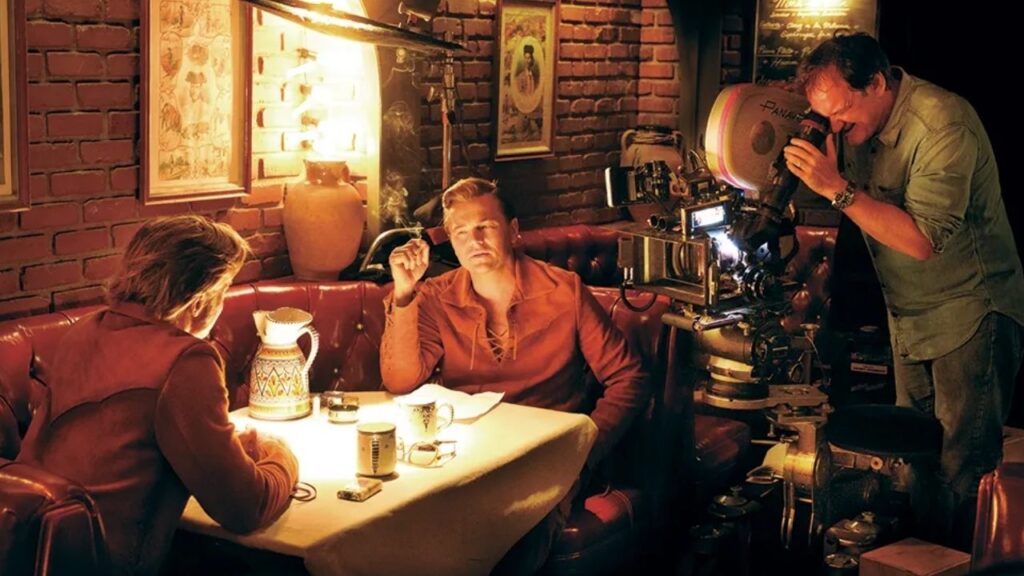
At the same time, building that world required the right creative team. Tarantino reunited with longtime collaborators like editor Fred Raskin, cinematographer Robert Richardson, sound editor Wylie Stateman, and makeup department head Heba Thorisdottir. Meanwhile, new additions like Barbara Ling and costume designer Arianne Phillips played a major role in strengthening the film’s authenticity.
How Costumes and Background Characters Helped Recreate 1960s Los Angeles
Once the foundation was in place, attention turned to costumes. Tarantino offered an unusual direction, asking Arianne Phillips to imagine the wardrobe as if the film were to be shot in black and white. Although he later admitted, “I was never really going to do this,” the idea helped avoid colors that did not belong to the era. He even suggested, “What if we did it in black and white so we can get rid of the colors?”
In case you missed it: How Quentin Tarantino’s Greatest Character Ever Became His Most Terrifying Creation
As a result, Phillips built a wardrobe that felt grounded and believable. She explained her process clearly: “I saw every single person. My thing is fit to the face; don’t fit to the body.” In addition, she created backstories for extras, noting that “It helps people to take pride in their work… and really put a fingerprint in helping to tell the story.”
Consequently, even background characters began to stand out. Tarantino pointed to a scene featuring Margot Robbie as Sharon Tate in Westwood and said, “When Sharon Tate is in Westwood, and I see the people crossing the street, I love the girl in the suede black boots… I was so intrigued. You can live or die by the extras.”
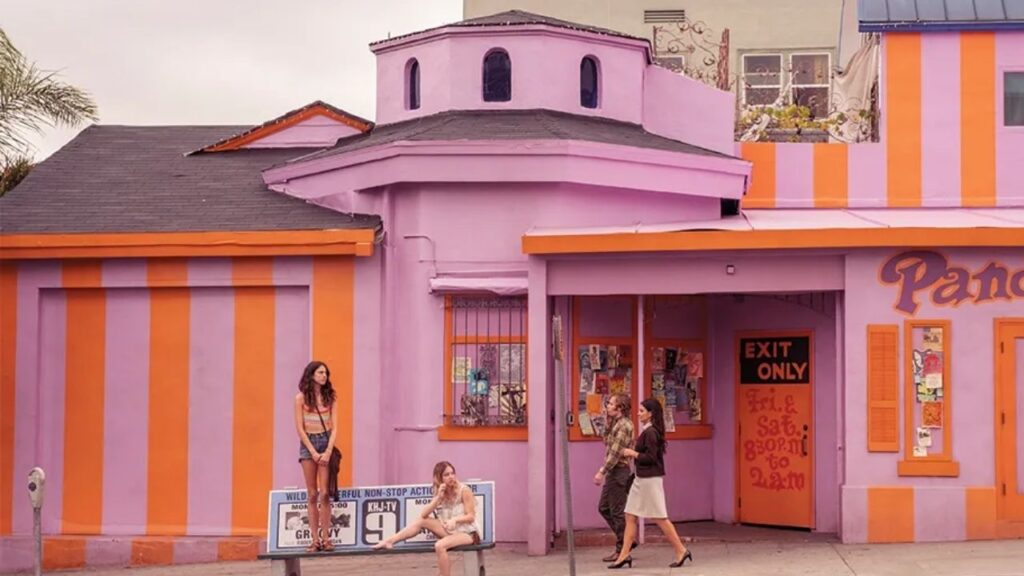
Similarly, another moment outside Pandora’s Box caught his attention. One woman reminded him of Jacqueline Kennedy Onassis. And he said, “She’s either a secretary or a wife, and I wanted to follow her story.” Even brief appearances added depth and made the world feel believable.
While costumes defined the people, Barbara Ling handled the physical environment. She transformed sections of Hollywood Boulevard and recreated sets for shows like The Green Hornet and Lancer. In addition, she rebuilt Spahn Ranch, a location tied to the Manson Family.
Because of this attention to detail, Tarantino described her work as almost magical. One example he often mentioned involved turning a falafel shop next to the Vogue Theatre into an Orange Julius. The transformation looked so convincing that he said he wanted to buy it and preserve it exactly as it appeared on screen.
In the end, every element in ‘Once Upon a Time in Hollywood‘ works together to recreate 1960s Los Angeles in a believable way. Costumes, extras, and set design connect seamlessly to build a world that feels real rather than staged. Instead of simply presenting the era, Tarantino places the audience right inside it.
You might also like to read: Why Christopher Nolan And Quentin Tarantino Will Never Agree On Alfred Hitchcock