

The ’80s, often labeled as the Decade of Greed, were a time when the masses championed a free market. The decade was brimming with uprisings and movements such as neoliberalism. It also, however, witnessed dissent to these very moments, which is perfectly captured in Paul Bartel’s film ‘Eating Raoul.’
This 1982 masterpiece remains underappreciated and a lesser-known Hollywood gem for many reasons. It starred Bartel in his absolutely sanctimonious self as the main lead. He also directed this feature film that, to this date, remains an anti-capitalist nightmare for many reasons. The movie offers a refreshing take on the consumption culture and exploitation as seen through the characters’ lens, and here’s how it does so.
When The Exploiter Becomes The Exploited
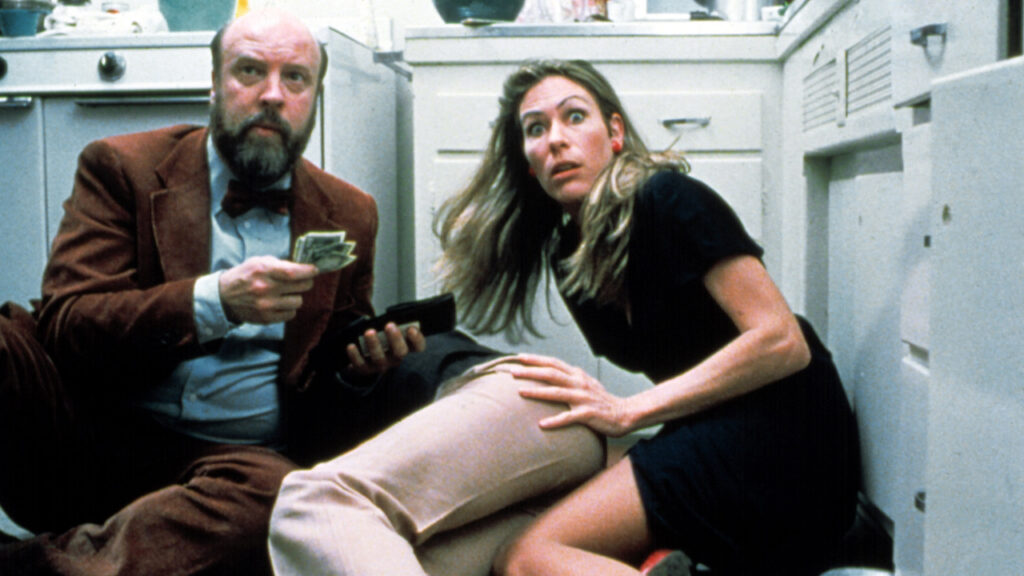
Eating Raoul doesn’t spare the rod and spoils the abuser. It exploits the exploiter and turns the tables on them. Right from the get-go, Mary, Paul’s wife, is violated by a man who is then killed by Paul.
This initiates a cycle of violence that catalyzes the pair’s quest for their dream life. They achieve this by holding the rich people accountable. It is mainly because both Paul and Mary are in a dire state; while one is fired from the job, the other faces harassment at work.
However, it doesn’t end there, as she is faced with assault numerous times in the movie. The result is that the abusers are killed off by Paul, and that includes Raoul as well.
Exploiters often capitalize on the vulnerabilities of people to extort money and even prompt individuals to engage in illicit affairs. Raoul uses this very ruse of a locksmith to rob people and has the upper hand against both Paul and Mary.
He learns the truth of the couple’s shady business and how they give off the corpses to the dog food company, but he joins the pair. Together, the trio flips the script by targeting the cream of the crop.
Be it mixers or swinger parties, they leave no stone unturned. In a capitalistic setup, where one witnesses the daily grind and glow trope, here it’s quite the opposite. The lecherous banker, the swingers party guests, and even Raoul. This points to Bartel’s commentary on the entire practice of consumption.
Related: How ‘A Midsummer Night’s Dream’ Became A Glittering Hollywood Nightmare
Paul Bartel’s Commentary On Consumption Culture

Consumption isn’t limited only to material goods but also to something that extends to the body itself. Sometimes it is food; other times it takes a cannibalistic tone.
This is a true case with all the victims who are ultimately fed to the dogs. This is something Raoul discovers when he follows the trails only to end up as food himself, and it is quite the scene.
The people who are all ultimately robbed become entrapped in the very system they create, even Raoul. This also includes the banker who tried to throw his advances at Mary, only to get a taste of his own medicine. It gives a whole new meaning to eat the rich, but that’s not all.
In that era of consumption, Paul and Mary became an opposing force to that ever-consuming greed. Instead of falling victim to the system that leaves them with debt, they take the reins and make their dream come true during the 80s.
This is significant mainly because at this time America was marked significantly by public debt. The movie offers a sense of utopia for both characters to carry out their vices when, in reality, things would be different otherwise.
In case you missed it: The Sad Truth About Joan Crawford’s Career After the Golden Age of Hollywood
In conclusion, consumption ends up with a cannibalistic flair as both feast on Raoul, and here the violence isn’t gory. It is rather discreet yet potent as he becomes the fodder for someone’s fantasy.
The movie becomes an anti-capitalistic nightmare with how it treads on the path of justice and morality. This applies to the characters who defy and refuse to succumb to a system that eats them alive socially, morally, and mentally.
So what do they do? They eat up the system themselves, or in other cases, they feed it to the dogs. It is not your usual, run-of-the-mill black comedy feature film.
Rather, it is a reminder of a debilitating and morally corrupt social system that fuels itself by preying on and encroaching on a person’s disadvantages and suffering.
You might also want to read: How Billy Wilder Turned ‘Some Like It Hot’ From a Box Office Walkout Into a Timeless Comedy Classic