

“What is life but a series of inspired follies? The difficulty is to find them to do.” This George Bernard Shaw quote kept buzzing in my head while watching ‘Margo’s Got Money Troubles.’
Most of us grow up believing life is about making the right choices: study well, pick the safe path, avoid mistakes. But Elle Fanning’s show flips that idea. It asks what happens when life doesn’t give you real options, and you’re left choosing between things that don’t fully work but still have to be done.
That’s why my expectations going in feel almost naive now. I assumed Margo’s story would be a modern take on ‘Gilmore Girls‘ or ‘Ginny & Georgia‘—a young single mom, a messy life, but still manageable in some way. The usual pattern: problems come up, she adjusts, and somehow things get resolved. Very Lorelai Gilmore kind of energy. But that expectation breaks within the first couple of episodes. What’s left is a far more uncomfortable reality of motherhood turning into something close to an existential crisis.
Everything Hits Margo At Once in ‘Margo’s Got Money Troubles’

Right from the start, Margo’s life doesn’t build up to a crisis. It begins in one. She’s impregnated by her professor, who tells her she’s a great writer, and she falls for it. When things fall apart, he disappears, leaving behind a $50,000 fund—significant, but nowhere near enough in the long run.
Now, she’s just given birth. Her body hasn’t recovered, she hasn’t slept, and she has to return to her apartment and deal with everything alone. Life doesn’t slow down for her, and the show doesn’t offer her a moment to settle. As Leo Tolstoy once wrote, “The two most powerful warriors are patience and time.” But Margo doesn’t have the luxury of either.
Related: No Kids, No Regrets: Celebrities Who Decided Motherhood Isn’t for Them
There’s a scene where she struggles to carry her baby up the stairs to her apartment, and it quietly sets the tone for everything that follows. It’s not about one difficult task—it’s about everything happening at once: her body still recovering, her baby depending on her, and her life already demanding more than she can handle.
There’s something very relatable in her struggles, even if you aren’t a parent. Isn’t that how life feels now? You deal with one problem while several others sit in the background. Money, responsibilities, and expectations don’t wait. Add to that the constant pressure of the digital age, and everything starts to pile up at once. There’s no real order to it.
My Money Is My Money, And That’s The Point

In this economy, you can’t rely on “community” to raise a child. When Margo turns to her mother, Shyanne (played by Michelle Pfeiffer), for help, she draws clear boundaries. She’s raised a baby alone once; she doesn’t want to do it again. And she certainly doesn’t want the financial burden.
The show is unusually direct about money. Shyanne looks put-together, but it explains how she manages it: a rent-controlled house, an old car, employee discounts at Bloomingdale’s. Even her makeup and those dated but expensive jeans are accounted for. Most shows expect you not to question how characters afford their lives. This one leans into that question, especially in its Californian setting.
Margo’s roommates back off from babysitting or pitching in money. A baby being cute doesn’t override their priorities. They want to study, they want to sleep, and they’re not willing to deal with a crying infant. They don’t even mind moving out.
Every Choice Margo Makes Still Leaves Her Stuck

As the story moves forward, you start asking a simple question: what exactly is Margo supposed to do? Yes, having a baby was her choice. Everyone warned her it would upend her life. But when you grow up hearing about the joys of motherhood, you don’t stop to think about the cost.
Her reality is straightforward but brutal: she needs to work, but she also needs childcare. And once you factor in that cost, most of what she earns disappears. Even when she manages to arrange help, no employer wants someone with unpredictable availability. That’s where the show really lands. It doesn’t feel like she’s making bad decisions; it feels like none of the available choices actually work.
In case you missed it: Top 20 Movies And Shows That Are Brutally Honest About Motherhood
And then there’s the way people talk to her. We’ve all heard it: “You got this.” Her mom says it too: “You’re a mother, mothers make it.” And the question sits there, unspoken but clear: why? Why do mothers always have to “make it”?
Because how often do we say things like that just to fill the silence? It sounds encouraging, but it doesn’t change anything. The problems remain exactly where they are.
A Flawed Family That Still Shows Up
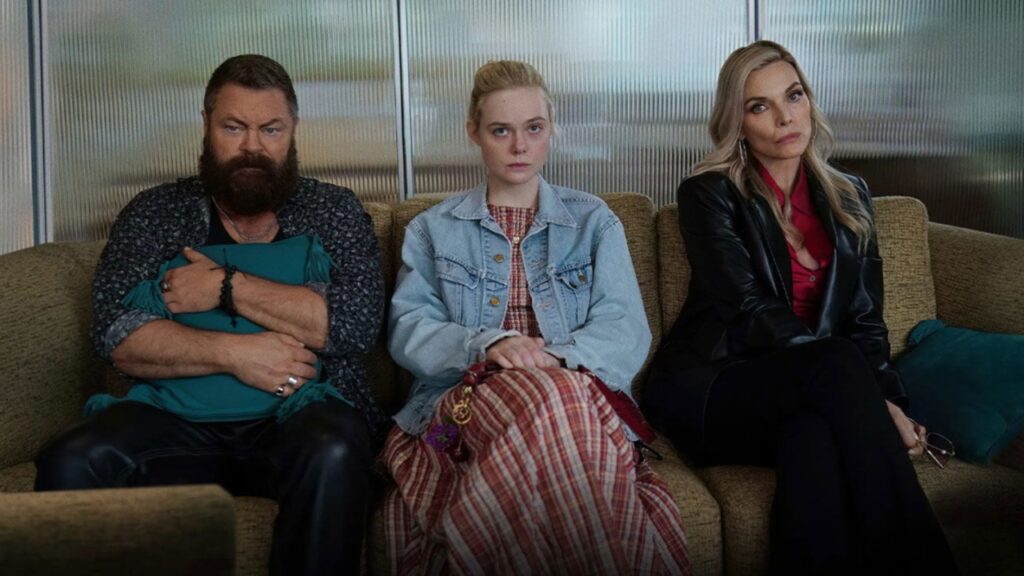
Maybe it was never about making wrong decisions. It’s about having limited options to begin with. You try to do the right thing, but the situation doesn’t really improve. And no one is fully honest about how difficult it actually is. Margo isn’t in control. She reacts to what comes her way and keeps going. The people around her operate within that same reality. They don’t fix things, but they try in small, imperfect ways.
Her dad (Nick Offerman) returns from rehab and offers to help with the baby. He’s trying, even if he wasn’t there before. Her mom may not agree with her choices, but she still shows care in practical ways, like buying a stroller using her store discount. And it makes you think… Maybe this is what support actually looks like. Not perfect, but still something to hold on to.
Margo Finds Her Own Way To Survive

Margo also finds her own way to earn money. It’s not a traditional job, and it’s tied to sex and art, but it works for her. Her upbringing makes her more open to choices like this. Not everyone will agree with it, and the show doesn’t ask you to. It simply shows why it makes sense for her.
There’s a powerful idea here: ‘Margo’s Got Money Troubles‘ doesn’t treat life as something that can be ruined by a single decision. It shows people adjusting, enduring, and sometimes even finding something meaningful in unexpected places.
Margo turns to options that weren’t part of her original plan, but they help her get through the moment. It reflects a larger reality: people don’t always have the luxury of choosing the ideal path. And, you can’t escape accountability.
The show also points out how people can work multiple jobs and still not get ahead. The system itself doesn’t support them, and one unexpected problem can change everything.
Still, it doesn’t feel completely hopeless. The characters want something better. They keep trying, even when things don’t improve quickly. That effort, however imperfect, keeps the story grounded.
By the time I finished the episodes, I had to let go of the comparison I started with. No, this isn’t a comfort story. If anything, it made me think: if this is how things actually work, maybe the problem isn’t that people aren’t trying hard enough. Maybe life has simply become much harder to manage than we admit, and all we can do is deal with it.
You might also like to read: 25 Best Shows On Apple TV+ Right Now, Ranked