
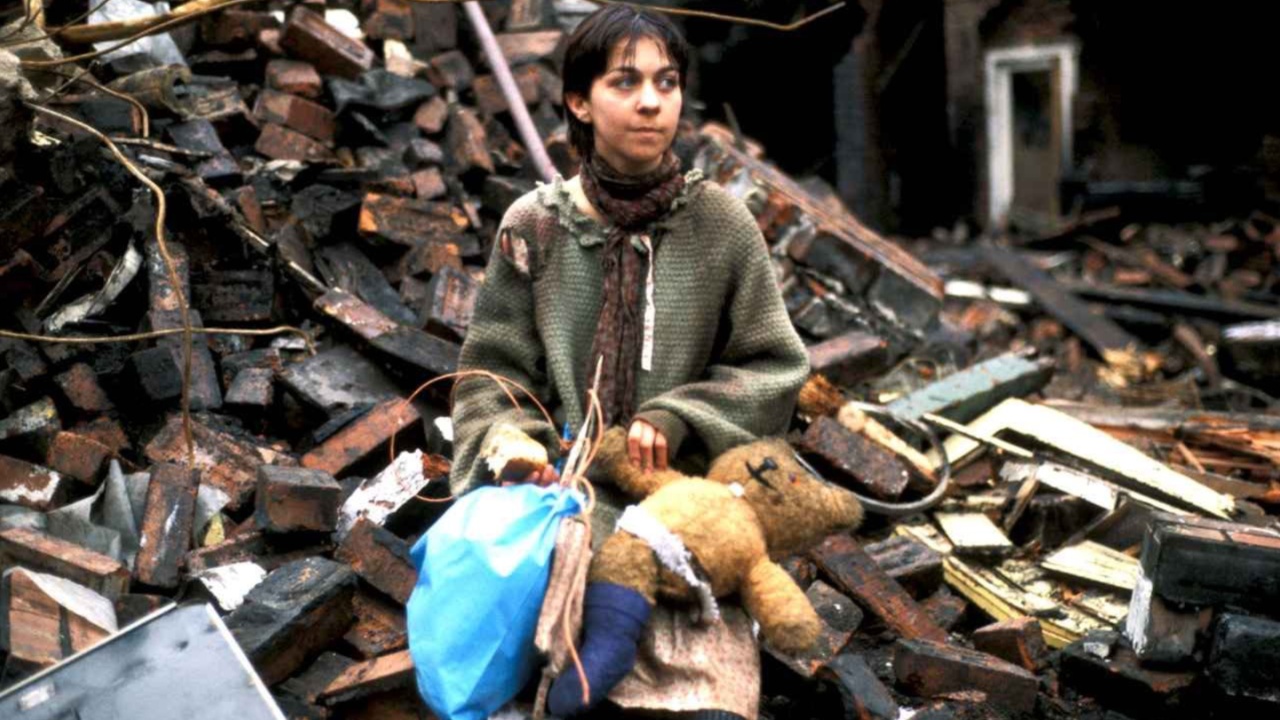
Some films are remembered because people loved them. ‘Threads‘ is remembered because people survived watching it. When the BBC aired the nuclear-war drama in 1984, it unsettled viewers, frightened them, and, in many cases, followed them into adulthood.
That’s the strange legacy of ‘Threads.’ It became less like a film and more like a shared trauma, a vision about what happens when civilization ends. And decades later, it’s still one of the most realistic depictions of humanity’s worst nightmare.
How ‘Threads’ Went Further Than Hollywood Ever Dared
In many ways, ‘Threads‘ feels like it came too early, and people are only now starting to understand it properly. ‘Threads‘ begins in a completely ordinary and raw world. Jimmy and Ruth are not soldiers, politicians, or scientists. They are simply a young couple trying to build a future together. Their relationship dominates the opening section of the film, and their concerns are very familiar: Ruth is pregnant. So, families meet, marriage plans move ahead, and life appears to be moving in a predictable direction.
But what starts as a mundane snapshot of everyday life in Sheffield, England, quickly transforms into something unimaginable when the Soviet Union and the United States go to war.
Soon, television broadcasts become increasingly alarming, and uncertainty gradually enters everyday life in Sheffield. International politics begins influencing local conversations. Regular people who were thinking about work, family, and daily responsibilities suddenly find themselves thinking about war.
Related: 10 Best Movies About Nuclear War
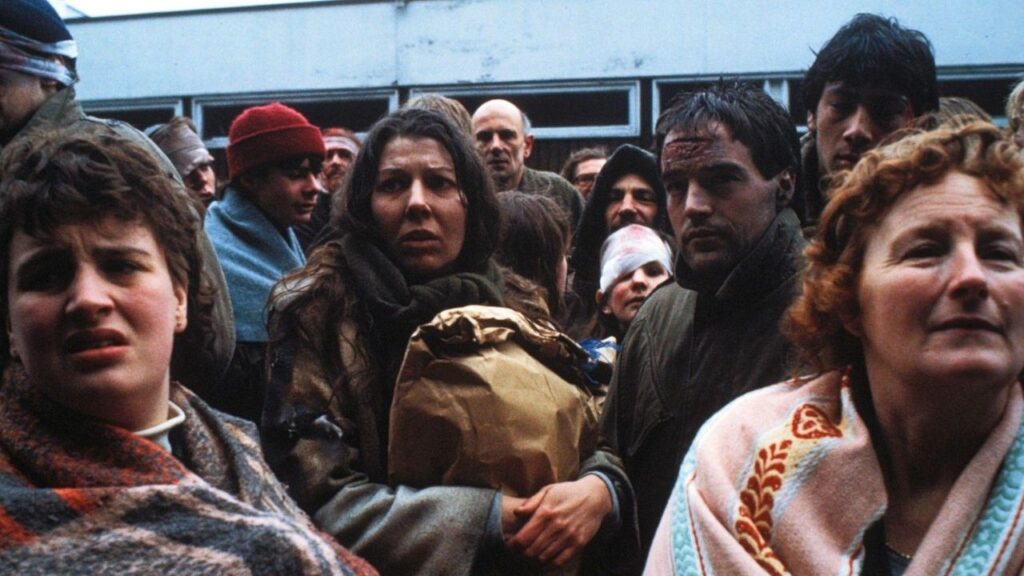
As fear spreads, some residents panic while others remain oblivious to the catastrophe unfolding around them. Although Britain isn’t part of the conflict, the destruction of a NATO base just 20 miles from the city irrevocably changes everyone’s lives.
Step by step, authorities provide instructions designed to help people survive. Yet the public response reveals an uncomfortable truth. Knowing what should be done and actually doing it are very different things. Despite repeated warnings, people rush to stores and begin stockpiling food, groceries, and household essentials. Shelves empty rapidly. Anxiety spreads across the city.
At the same time, protest groups take to the streets. Demonstrations and rallies become part of everyday life as people react to the growing crisis in different ways. Some prepare for the the impending disaster, others deny it. The film perfectly captures a society struggling to process information that feels too frightening to accept.
Equally important is the film’s visual approach. ‘Threads‘ avoids any larger-than-life approach. Streets look familiar. Homes look ordinary. Shops, schools, and public spaces resemble places viewers have known all along. As a result, the fear feels very real.
The Real Disaster Begins After The Nuclear Attack
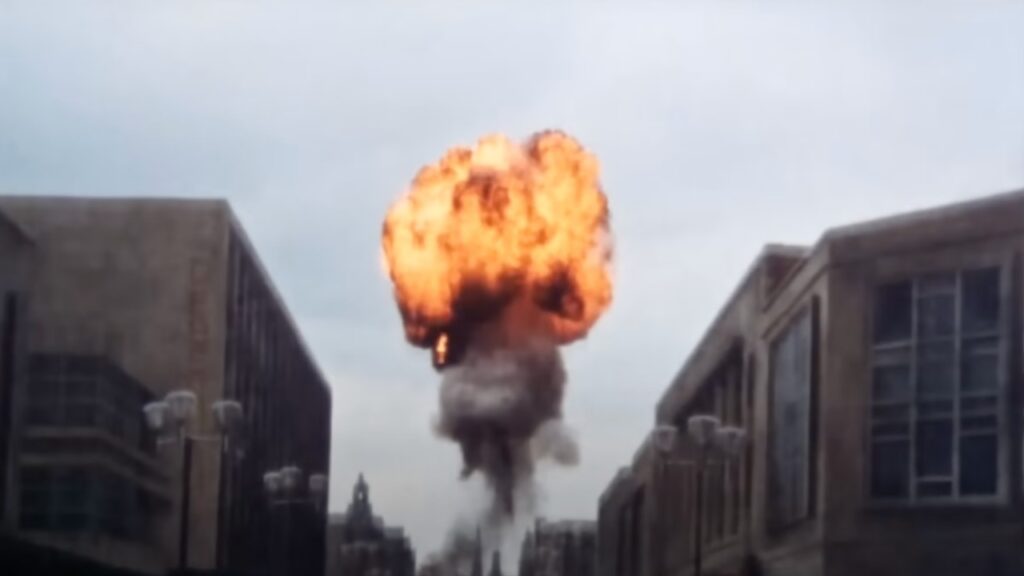
Unlike many disaster films, ‘Threads‘ refuses to treat the explosion as the climax of the story. In fact, the attack functions almost as a checkpoint. The bomb goes off, and the real story begins.
Things slowly fall apart. Power stops. Food runs out. As chaos takes over Sheffield, people run through the streets in search of safety. Families retreat into their homes, believing that walls and roofs might protect them. However, the force of the explosions quickly destroys those assumptions.
In case you missed it: The Brutally Honest Timeline Of World War II Told Through These 10 Great Films
Buildings collapse. Windows shatter. Furniture becomes deadly debris. Ceilings crash onto families sheltering indoors. Death arrives suddenly and indiscriminately. The film repeatedly reminds viewers that every explosion creates another layer of destruction. One tragedy immediately leads to another.
One of the most heartbreaking images shows a mother sitting beside her dead child. The scene mirrors photographs associated with real wartime devastation and serves as a reminder that nuclear war cannot be measured solely through statistics. Every casualty represents an individual life and an individual story.
Furthermore, rescue workers, emergency personnel, and public officials continue trying to save lives. Yet many of them die while carrying out those responsibilities. The people society depends upon during emergencies gradually disappear alongside the people they are trying to help.
Slowly, the radioactive particles settle throughout the atmosphere and begin to block sunlight. Sheffield becomes colder, darker, and increasingly hostile. Dust fills the air. And, hope becomes increasingly difficult to exist in a world deprived of warmth and light.
As the days pass, the city begins resembling a vast crematorium. Bodies lie in the streets and ruined buildings. Entire neighborhoods appear abandoned. Death becomes such a common sight that survivors are forced to continue living among it.
‘Threads’ Is Ultimately A Story About Humanity Losing Itself
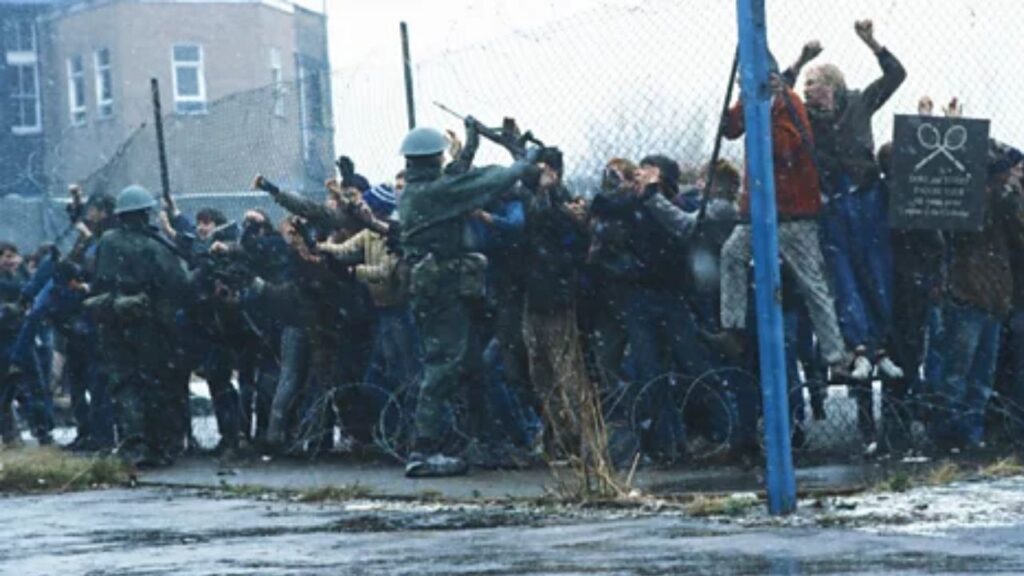
If the attack itself is horrifying, the survival proves even more devastating. Sure, the explosions end, but there’s no electricity, food, clean water or medical care. Families face situations that would have seemed unimaginable before the war. Dead relatives remain inside homes because nobody arrives to remove them. In some cases, people place bodies in unused rooms and continue living in the same house for days.
Today, those scenes feel especially unsettling because they bring back memories of the COVID-19 pandemic, when many families experienced isolation, loss, and limited access to support. Of course, ‘Threads‘ imagines circumstances far worse because every institution crumbles at the same time.
Related: 20 Most Unforgettable Disaster Movies Of All Time
Meanwhile, disease and hunger create additional suffering. People struggle to find food. They struggle to find water. They struggle to stay healthy. Fear spreads rapidly through communities already pushed to their limits. Even when authorities identify homes capable of sheltering survivors, some homeowners refuse to let others inside to avoid contamination.
As conditions continue deteriorating, the film introduces one of its most unforgettable images. Pregnant Ruth finds an empty can on the street and drinks water from the gutter. It shows how dramatically society has regressed. In many ways, ‘Threads‘ suggests that humanity is moving backward through history. The civilization appears to be reverting to the Stone Age, where survival takes precedence over everything else.
The conveniences of modern life disappear. No more public services, healthcare, or educational structures. One by one, the systems supporting civilized life vanish. Eventually, survival becomes the only priority.
This idea becomes even more powerful near the end of the film when Ruth gives birth. At the beginning of the story, pregnancy symbolized hope, continuity, and the promise of a future. By the time the child arrives, that future has nothing to offer to the newborn.
An entirely new generation must now live with the consequences of decisions made by their predecessors. As the years pass, conditions grow even worse. Social structures give into dysfuction. Language begins to change. Communication becomes increasingly limited. The Sheffield seen at the end barely resembles the city introduced at the beginning.
That gradual decline is what makes ‘Threads‘ so utterly scarring. The film does not present nuclear war as a single catastrophic event. Rather, it presents it as a chain reaction that continues long after the explosions have ended. It is also the reason ‘Threads‘ continues to resonate decades after its release, and feels just as relevant now as it did in 1984.
Why ‘Threads’ Feel So Relevant After All These Years
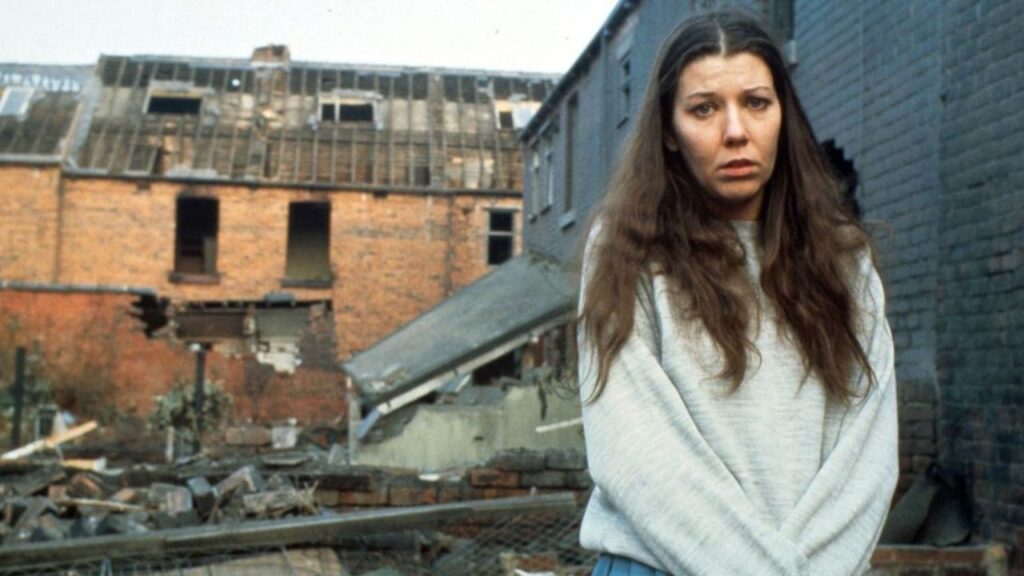
More than forty years after it first aired, ‘Threads‘ remains difficult to ignore because many of the fears it explores still exist today. The world is not living through the catastrophe depicted in the film, but concerns about war, global instability, and the fragility of essential systems continue to dominate headlines. That is precisely why the film feels less like a relic of the Cold War and more like a warning that still resonates.
Those concerns have become even more noticeable in recent years. As per The Bulletin of the Atomic Scientists, the Doomsday Clock was set at 85 seconds to midnight on January 27, 2026, the closest it has ever been, because of nuclear risks, war, AI dangers, and weak global cooperation. They also warned that military operations in three different areas were happening under the shadow of nuclear weapons.
Even the crisis in the Middle East doesn’t come as a surprise. There have been constant reports of rising oil prices and shortages, and that is where ‘Threads‘ becomes practical. A war can break the channels people depend on.
The Guardian reported that UK food prices are on track to be 50 percent higher by November 2026 compared with the start of the cost of living crisis in 2021. The rise has been linked to energy shocks, climate events, supply chain disruptions, and wars, including the conflicts in the Middle East and Ukraine.
This does not mean 2026 is the world of ‘Threads‘. But it does show why the film feels so hard to ignore now. One crisis affects fuel. Fuel affects transport. Transport affects food. Food affects families. The film takes that chain reaction to its most extreme point, but the basic idea is easy to understand.
By the time the film reaches its final moments, it no longer feels like a disaster story. There is no assurance that things will improve, and this leaves viewers pondering a question the film never answers directly. If this is what survival looks like, then what does survival really mean?
You might also like to read: The Real Disturbing Story Behind ‘Lord of the Flies’ That Inspired the BBC Series